The Capstone: Architecting the Whole Platform
The whole series in one system — designing, integrating, evaluating, and governing the bookshop's enterprise support platform end to end, domain by domain, followed by the exam's three sample questions worked with their rationale.
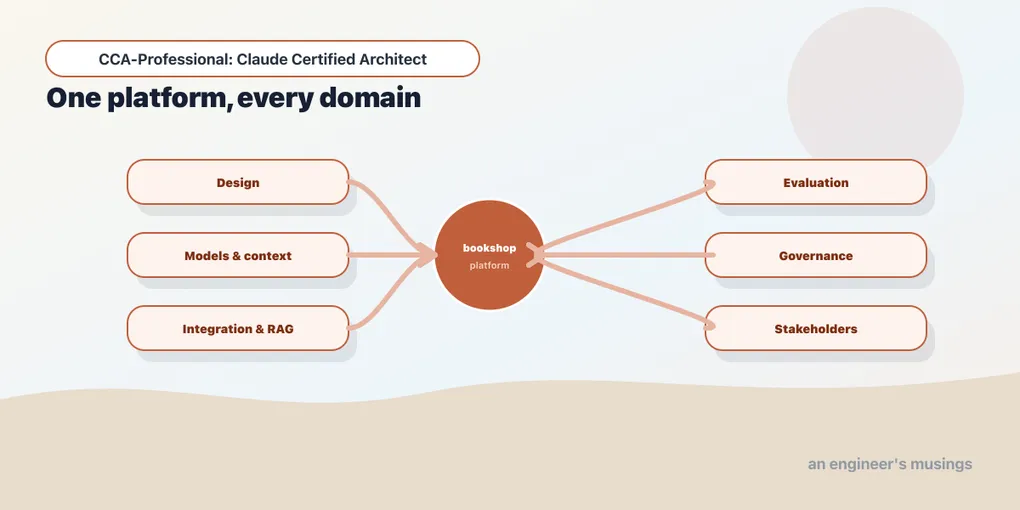
Twenty chapters, seven domains, one system. This capstone assembles them into the bookshop’s enterprise customer knowledge-and-support platform. We design and defend it the way an architect actually delivers one: from the business problem down to the running, monitored, governed system. Then we work the exam guide’s three sample questions. The point of the credential is recognizing each item as a decision you’ve now made in context.
The platform, domain by domain
The system from chapter 0: a customer-facing assistant answers questions and resolves issues, backed by retrieval over a private corpus, holding customer PII, meeting cost and latency SLAs, evaluated continuously, observable, and governed. Every domain of the exam is a real decision in building it.
Solution design (D1). It starts before any code. You discover the real problem behind “help customers faster”: the deflection rate the business actually needs, the value pillar it optimizes (cost per contact), and whether Claude is even the right tool. For the templated 40%, a cheaper path might win. You choose the architecture pattern per part — an augmented-LLM retrieval answer for the common question, an agentic loop for the open-ended case. Then you decompose the system into a support coordinator over a knowledge-retrieval component and an order-actions component, complete and disjoint.
Models, prompting, context (D2). You route by model tier — Haiku for retrieval-answers and intent routing, a stronger model for refund reasoning — pinned to snapshots. The system prompt carries the role, the output contract, and the trusted-instruction layer, with few-shot examples where consistency matters. The large, stable policy prefix is cached while the live user turn stays uncached. Measured: ~4,777 tokens written once, then read at a tenth of the price.
Integration & RAG (D3). Shared capabilities live behind MCP servers; app-local logic stays a custom tool; capability bloat is resisted. The RAG pipeline chunks, embeds, indexes, and retrieves over the policy/catalog/help corpus, and retrieval is targeted. Verified live: a doc_type metadata filter turned a wrong-chunk refusal into a correct, cited answer. Tools run under least privilege, authorization enforced in code. The whole thing is observable, with the usage object as the cost-and-latency meter.
Evaluation & optimization (D4). Nothing ships on vibes. An eval harness scored the assistant 7/7 on a representative dataset with an LLM-as-judge you validated. A/B testing proved grounding’s worth: an ungrounded variant scored 2/7 and confidently claimed the shop ships to the UK when it doesn’t. It also gave you a diagnosis discipline for when a number regresses. Then you optimize against the SLA: cache the prefix, route by task, trim tokens, never blind.
Governance & risk (D5). Guardrails enforce what the model can’t be trusted to — a PreToolUse deny on destructive actions, human approval on refunds over a threshold. The design meets its data obligations: PII minimized, encrypted, retained to a limit, audited, with a GDPR deletion path. It’s built to detect and mitigate bias, cite its sources, and disclose that it’s AI.
Stakeholders & lifecycle (D6), and enablement (D7). You communicate the tradeoffs so a business owner can choose quality against cost against latency, and set the SLA. You document the decisions and their rationale and run the lifecycle as a loop. The Arc 4 evals feed the iteration that a never-”done” system needs. And you enable the team with shared Claude Code conventions and an AI-assisted review pipeline.
That’s the whole blueprint, and it’s one coherent system — no domain is decoration.
The sample questions, worked
The guide publishes three sample items. Worked with their rationale, they show the reasoning the whole exam rewards.
Sample 1 (Domain 3 — Integration). A support agent has read-tickets, draft-replies, issue-refunds, and delete-accounts tools; staff only ever need read and draft. Applying least privilege, which change best reduces risk? → Remove the refund and delete tools from the agent’s configuration entirely. Least privilege means eliminating a capability the role doesn’t need. That removes the attack surface — an injection can’t invoke a tool that isn’t there. Logging (a detective control) and a confirmation prompt (a compensating control) leave the dangerous capability present. A bigger model doesn’t change authorization scope at all. This is chapter 10 exactly: remove, don’t guard.
Sample 2 (Domain 2 — Models, Prompting & Context). An 8,000-token system prompt and policy document ship on every request, followed by a short varying user message; latency and cost are both concerns. Which optimization addresses both? → Place the static system prompt and policy before the dynamic content and enable prompt caching. A stable prefix cached is reused on every subsequent call, cutting both time-to-first-token and per-request cost without discarding any needed context. Verified: a ~7,957-token static prefix served from cache. Truncation loses policy the assistant needs. Blindly downsizing the model risks quality. Moving the policy into a few-shot block creates no cacheable prefix. Chapter 14.
Sample 3 (Domain 4 — Evaluation & Optimization). A RAG system suddenly returns confident but incorrect answers after a document refresh, while latency and model version are unchanged. Where do you look first? → The retrieval/indexing step is returning irrelevant or stale chunks. The trigger is the document refresh, and model and latency are constant. So the change is in what retrieval feeds the model — a broken re-index or mismatched embeddings. Verified in chapter 13: holding the model and prompt fixed, a bad refresh flipped a correct “30 days” into a wrong “14 days.” The model was innocent; the context was poisoned.
The instinct behind the answers
Read the three together and the same architect’s reasoning recurs — and it’s the exam’s real content:
- Reduce the surface, don’t monitor it. Security is removing the unneeded capability, not logging its misuse. The strongest control is the one that makes the failure impossible, not observable.
- Match the fix to the actual constraint. Caching addresses latency and cost because it reuses a real prefix; truncation and downsizing attack the wrong thing. The question always contains the constraint that selects the answer.
- Isolate the variable that changed. A regression after a document refresh, with everything else constant, points at retrieval — not the model. Diagnosis is subtraction: hold constant what didn’t move, and look where it did.
When an exam item offers a capability-removing control against a monitoring one, a constraint-matched optimization against a plausible-but-mismatched one, or an isolate-the-change diagnosis against a guess, the first is almost always right. That instinct is what CCA-Professional is built to reward: architecture as the disciplined reduction of a problem to the decision that actually moves it.
Final thoughts
The credential asks whether you can design, integrate, evaluate, and govern a production Claude system and defend the choices. This series answered it by architecting one — a support platform that retrieves and grounds, routes and caches, evaluates and optimizes, guards and complies, and is handed off to a team to run and iterate. Where the work was code, it ran against a real pipeline. Where it was judgment, it was reasoned in the open and labelled as such. Go design the system your own blueprint describes — a real one, end to end. Then the exam stops being questions and becomes a description of decisions you’ve already defended. That’s the whole point of the credential, and of this book.
Back to the exam overview, or start designing — the best preparation is a production system you architected yourself.
Comments